A custom saddle should feel like a long-term relationship—not a disposable fling. Joyseat is built with sustainability in mind: local manufacturing where it makes sense, a modular design, and 3D-printed TPU padding that can be refreshed or reprinted instead of replacing the whole saddle. Here’s how our recycling-minded approach fits directly into your Joyseat purchase.
Sustainable Production Through Local Manufacturing (and a Smarter Way to Own Custom)
Sustainability in cycling often gets reduced to one question: “Where was it made?”
That matters—but for products you sit on for thousands of kilometers, there’s a bigger lever: how long it lasts, and what you can refresh instead of replacing.
Joyseat was designed to be the opposite of disposable. It’s a custom saddle built through a mix of advanced manufacturing and local craftsmanship, and it’s structured in a way that supports repair, upgrades, and (where possible) recycling—without forcing you back to square one.
Below is how that sustainability story connects directly to your Joyseat purchase.
The sustainability mindset: fewer full replacements, more smart refreshes
Traditional saddles usually fail in predictable ways: foam packs down, the surface deteriorates, and riders replace the whole thing. With Joyseat, we focus on extending product life by designing around two principles:
-
Durable materials where it counts
-
Modularity—so worn or damaged parts don’t automatically mean a brand-new saddle
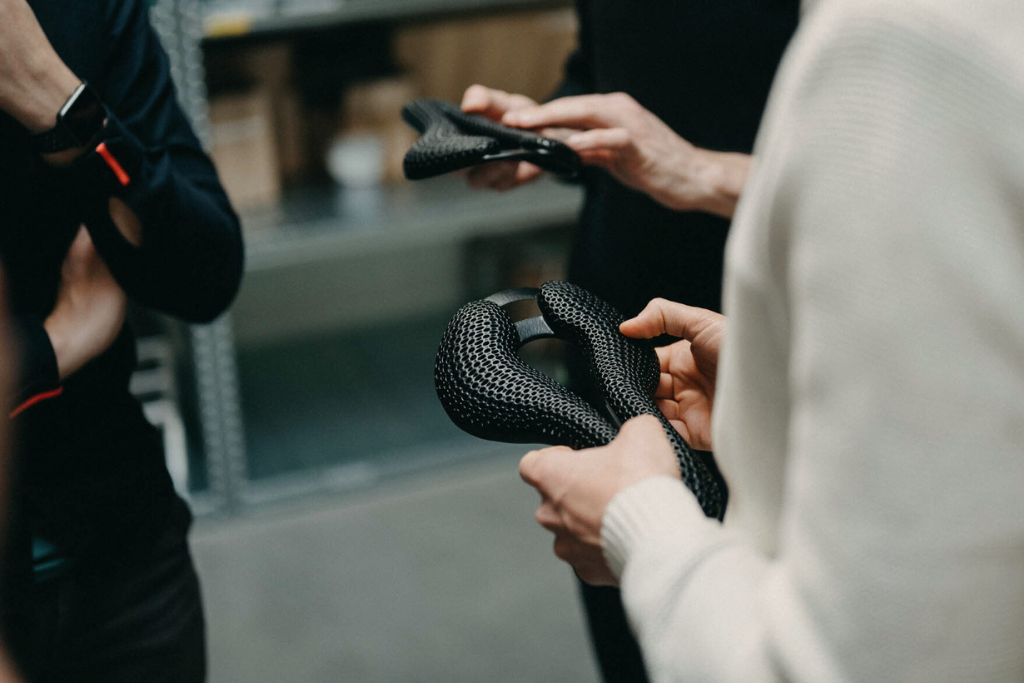
Joyseat is made as a system. The part that does the comfort work is the custom 3D-printed padding, while the shell + rails provide structure and compatibility (with different model options across the range).
Why TPU 3D padding is the key to recycling—and longevity
Joyseat’s padding is produced from thermoplastic polyurethane (TPU) using industrial 3D printing (Multi Jet Fusion). TPU is valued in this context because it’s elastic, durable, and—crucially—reprocessable compared to many traditional foams.
What this enables in practice
-
Long service life: TPU padding is designed to maintain its support characteristics longer than typical foam approaches.
-
Targeted replacement: If the padding is damaged or your needs change, it can be reprinted/refreshed while keeping the original shell.
-
Material recovery potential: We’ve explored a recycling pathway for worn/damaged TPU in collaboration with material partners (so the “end” of one product can become input for another).
Put simply: keeping the shell and swapping the padding is a lot less wasteful than binning a whole saddle.

How this connects to your Joyseat purchase
Here’s the important part: sustainability isn’t an optional add-on after checkout—it’s designed into ownership.
1) You buy one saddle built for long-term support
You order Joyseat once, using the Smiling Butt Kit + configurator inputs so the saddle’s size/shape/stiffness are tailored to you.
2) If your needs change, you don’t have to start over
Bodies change. Riding styles change. Bikes change. And sometimes, you simply want a slightly different feel.
That’s why Joyseat is designed with upgradeability in mind: you can refresh or update the 3D-printed padding while keeping the original shell.
3) If you crash, the goal is recovery—not replacement culture
Crashes happen. Confidence & Care includes support pathways (including crash replacement), and because the saddle is modular, in some cases only the damaged component needs replacement.
If you want the official details, read our 100% Confidence & Care policy (includes padding reprint).
Local manufacturing: sustainability that also protects quality
There’s another side of sustainable production that doesn’t get enough attention: quality control.
A product that fails early—no matter how “eco” the messaging—is not truly sustainable.
Posedla keeps a major part of production close to home to maintain strict oversight, consistent quality, and short supply chains. Local manufacturing also reduces transport intensity compared to long-distance, multi-step global supply chains.
And yes—this also supports real people and skills in Northern Bohemia, where we’re based.

The harder problem: carbon recycling (and what we’re doing now)
Not every material is equally easy to recycle. While TPU offers a realistic pathway for reprocessing, carbon composite recycling is still a global challenge, especially with cured resins.
Right now, the most practical options for cured carbon are limited (often involving grinding and reusing as filler material), so we focus on:
-
Minimizing waste during production
-
Finding secondary uses for offcuts/scraps
-
Tracking developments in carbon recycling methods as the industry evolves
This is one of those areas where we’d rather be honest than performative: the work is ongoing, and the best near-term impact comes from efficient use and long product life.

What “sustainable” should feel like on the road
Sustainability shouldn’t come at the cost of performance—or comfort. If anything, it should support the best kind of riding: the kind where you stop thinking about your saddle and just move through the world.
A custom saddle that lasts, adapts, and can be refreshed is a simple, practical version of sustainability: less trial-and-error, fewer full replacements, and more years of riding the thing that actually fits you.